Dahoga/Bonksoft Rule Set

Dahoga Rule Set

The Dahoga Codex

CODES OF CONDUCT

The Golden rule: Dahoga is an honour based game. While the chaos of melee leads to not knowing whether you have been struck or not, when in doubt it is better to assume you have been struckWhen people do not take their hits it causes arguments and leads to more dangerous gameplay as people use greater force to ensure that you feel their strikes.

Referee is the law: In many of these games, a referee will be present to judge whether someone has sustained a strike or not. In any and all cases the referee has the last word on the matter and holds the right to dismiss anyone from the battlefield.

Combat etiquette: Dahoga is a semi-full contact game. Medium force is recommended to fight withStrike too lightly, and it causes disputes as to whether one has been struck or not. Strike too hard, and it is a safety risk. It is advised to cater your strikes to the body weight ratio of those who oppose you. If they are smaller, strike softer, if they are larger, strike harder.

Code Red: Code Red is to be shouted during any emergency or if a player is badly hurt. All players must pause. The actions of players who are unaware of a Code Red do not count during a Code Red. If you feel that you are badly hurt, or if you see that another player is badly hurt, initiate a Code Red.

Good examples for Code Red are:

  • Ow-ows, such as bloody noses, split lips, heavy head hits, getting badly winded, heavy groin hits, ect…
  • Any injury, such as broken bones, sprains, cuts that may need stitches, concussions, ect…
  • Medical emergencies such as serious Asthma, heart attacks, epilepsy, etc…
  • Real fights.
  • Out-of-game emergencies.

UNARMOURED COMBAT RULES

Standard players

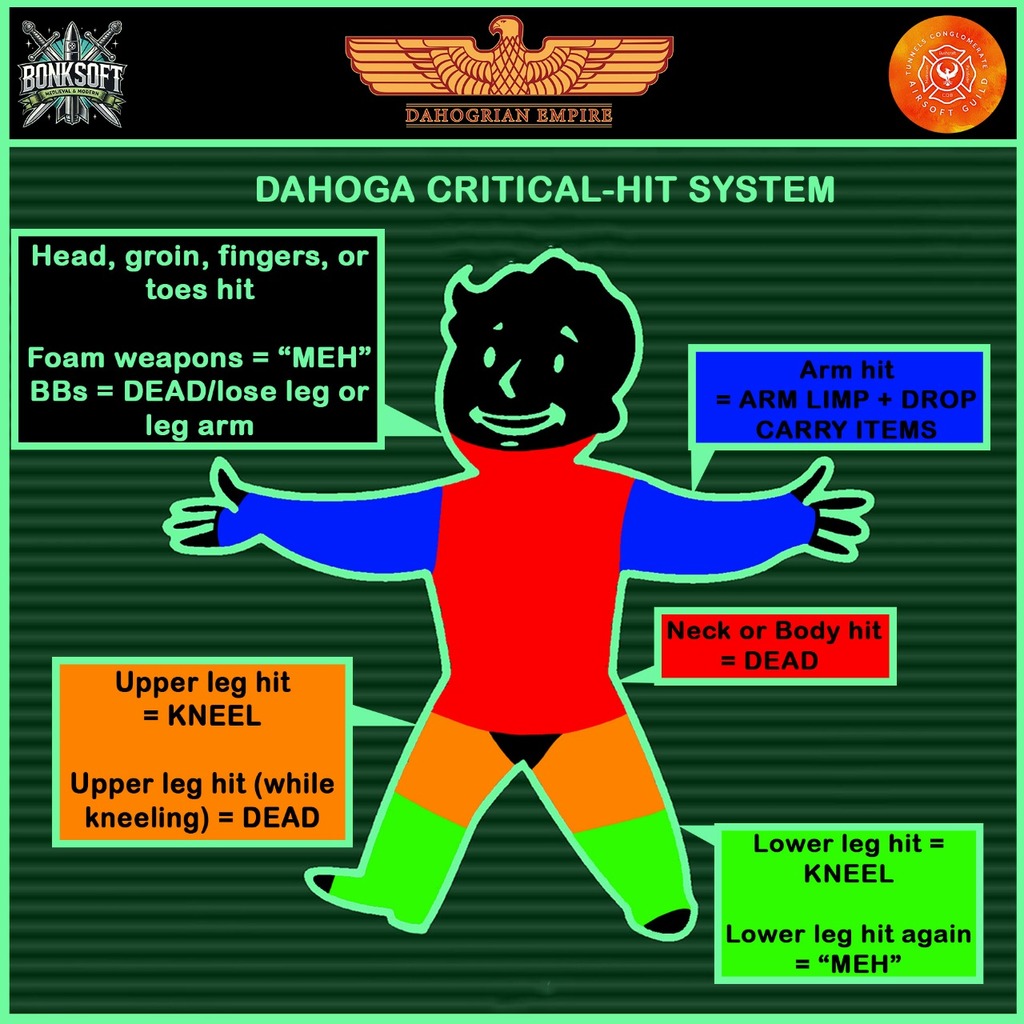
  • Head, groin, finger, and toe strikes do not count. Head and groin strikes are not penalised, though they are strongly discouraged. Repeat offenders risk being banned under extreme circumstances.
  • Torso strikes “kill” players.
  • The arm ranges from the hand to the shoulder socket. If stuck, the arm must drop what it is carrying and be placed behind the back.
  • A second strike to the same arm does not count.
  • “Maimed” arms may not be used to defend oneself.
  • If both arms are struck, the player is entertaining.
  • The leg ranges from the foot to the buttocks. If struck, the player must kneel with at least one knee on the ground. No hopping.
  • If the lower leg is struck multiple times, it does not count.
  • If the upper leg or buttocks are struck twice, the player is “killed”, regardless as to whether they have already been stuck in the lower leg. Upper and lower legs count differently, though being struck in either requires one to kneel.

Physicians:

  • Physicians must be labelled with a clearly visible blue Caduceus.
  • They can “heal” limbs by tying bandages (strips of cloth) onto the affected limb.
  • A limb may not have more than one bandage. If one is struck in their limb after it is bandaged, they are “maimed” or “crippled” for the rest of their “life”.
  • Physicians can “die” and “kill” like standard players.

Musicians:

  • Musicians are “killed” upon being approached or chased by a player who is capable of striking the musician and is in striking range, or if they are shot with a projectile. One may not strike a musician carrying a musical instrument.
  • When chasing a musician, shout “dead!” when in striking range.
  • Unarmed and “dis-armed” opponents cannot kill musicians, as they have nothing to strike with.
  • A musician may strike players in the back with a weapon, though if their opponent turns to face them and is still capable of striking back they are “killed”.
  • Dead Musicians play no music.
  • It is the musician’s own discretion to take a musical instrument into battle. They must take that risk knowingly.
  • A Musician becomes a Standard player as soon as they are not carrying a musical instrument.
  • Place your instruments in a hard protective case and out of the way when not in use. We are not responsible if it gets damaged.

ARMOUR RULES

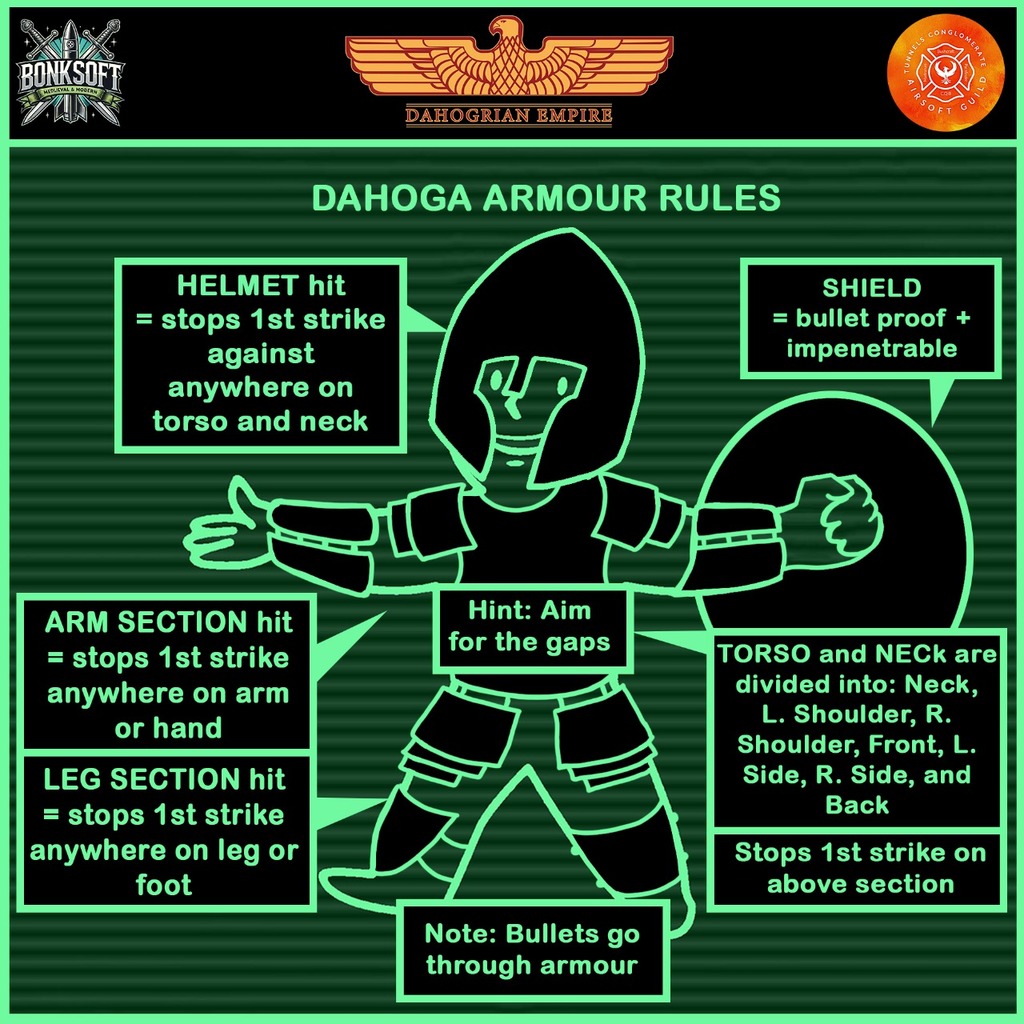
Body Armour is divided into segments:

  • Neck
  • Left shoulder
  • Right shoulder
  • Left Arm
  • Right Arm
  • Front torso
  • Left torso
  • Right torso
  • Back torso
  • Left Leg
  • Right Leg

  • If a segment is struck, it is “damaged”. Only a second strike to the segment “harms” the armour wearer.
  • When your armour is struck, shout “armour” to inform your opponent to inform them that the area they just struck is now unarmoured.
  • One may not “massage” your opponent and call it multiple strikes. One must pull back and strike again for an additional strike to count.

Note: If an armour gap is struck, the armour is circumnavigatedA wearer may have to be told if they are struck in a gap.

Helmets:

  • A helmet protects the player from the first strike to the neck or torso, or their neck and torso armour.
  • When a helm wearer is struck in the neck or torso they must shout “helm/helmet” to inform their opponent that their helm is now “damaged”.

For example, a helm and breastplate wearer must be struck three times in the chest to “die”.

Note: Head strikes do not “damage” helmets. Head shots do not count.

Authenticating armour:

  • Armour must be genuine OR decorated to match historical/recognised fantasy. It needs to be suitable to be an extra in a film set.
  • Material, or decorative armour, must have a minimum thickness of 2.5mm. This can be achieved through layering.
  • Armour must have a level of weight or heat discomfort.
  • “Decorated” armour does not count if decoration has visibly deteriorated/damaged/ripped.  

Notes: 

  • All armour is subject to an authenticity inspection by the present Generals and may only be used as armour if it passes the authenticity inspection.
  • If it fails inspection, it may only be worn if it is clearly not authentic.

Armour Safety:

  • Armour should not have any protruding spikes.
  • Armour, especially plate styles armour, must have adequate thick material or foam barriers on its edges to prevent chafing or cutting its wearer.
  • All lengths must be taken to prevent rivets and other protrusions from harming the wearer.
  • All helmets, regardless of their material, must have a padded arming cap or interior foam or thick material padding.

Note: All armour is subject to a safety inspection by the present Generals and cannot be worn if it does not pass the safety inspection.

Armour Etiquette:

  • Armour can be expensive, difficult to make, or made to a specific size. Please respect all armour that is not open access and do not put owned armour on without explicit permission.
  • Heavier armour such as metal plate, and absorbent armour such as gambeson can mask the wearer from being aware that they are hit. It is advised that attackers use more force when fighting armoured playersIt is also to be stated that if someone states that an armoured individual is struck on their armour, the armoured individual is not allowed to dispute it. Those who dispute this are at risk of being banned from wearing armour if there are excessive complaints.

WEAPON GUIDELINES

Weapon restrictions:

  • All weapons must undergo a safety inspection by the generals present before they can be used.
  • A weapon is not considered safe unless it can safely deliver a full-contact strike.
  • A weapon is not considered safe if the foam padding has deteriorated.
  • If a weapon is damaged, or found to be damaged in gameplay, it must either be set aside or made to be visibly damaged and still set aside.

Swing weapons:

  • Minimum of 3cm medium cell foam (camping mat or pool noodle) along the striking edge.
  • If a weapon has a flat edge, like the flat of a sword or axe, there must be a minimum of 2cm medium foam along the weapon’s hard core.
  • For weapons under 1.5m, stabbing tips may not exceed 8cm, and must be a minimum thickness of 4cm medium foam.
  • For weapons over 1.5m, stabbing tips must be made from 8cm of medium cell foam.
  • Minimum tip width of 2cm.
  • The maximum length is 2.3m.
  • Maximum weight is 1,5 kg per metre.
  • A minimum of ⅓ of the weapon’s length must be padded. However, an unpadded handle may not exceed 80cm.  
  • Axes, polearms, or any other headed strike weapons, must have a padded space under the head capable of safely striking your opponent. This must follow the above ⅓ rule.
  • The base, or boss, of every swing/strike weapon must be padded with 3cm of medium cell foam.
  • A flail's connecting rope cannot exceed 30cm.
  • A flail’s connecting rope must either be padded with 1cm of medium cell foam, or be made out of soft material.
  • Strike weapons cannot be thrown.
  • Weapon cores must be either PVC, graphite, carbon fibre, fibreglass, or hollow tubing. No bamboo or wood.
  • Heavier and harder cores will be under greater scrutiny during inspection.

Notes: It is recommended that the tip of a Swing weapon has additional closed or medium cell foam padding between the core’s tip and its padding. This is a requirement for hollow tubing. This is to prevent padding deterioration.

Stabbing/Thrusting weapons:

  • Striking tips must be a minimum of 8cm medium foam, and a maximum of 12cm.
  • Minimum tip width of 3cm.
  • Weapon cores must be either PVC, graphite, carbon fibre, fibreglass, bamboo, or wood. No hollow tubing.
  • Heavier shafts will be under greater scrutiny during inspection.
  • The weapon must be cut down to size if a crack is visible.
  • If the wood has splinters, it must be covered in tape.
  • Max weight of 2kg per metre.
  • No max or min length.
  • Thrusting weapons can parry and block with the shaft, though no swung or pull-back strike counts.
  • Do not swing a Thrusting weapon to do anything other than parry or block. Thrusting weapons do not have padded shafts and can cause injury when swung.
  • The shaft of a Thrusting weapon can be used to block and parry.
  • Cannot be thrown.

Projectiles:

  • Max draw weight of 35 pounds at 28 inches for bows.
  • Max draw weight of 35 pounds at 12 inches for crossbows.
  • No contemporary compound (pulley powered bows) allowed.
  • Minimum tip width of 2cm.
  • Arrows and throwing knives must have 5cm of medium foam at their points.
  • Javelins/pilums must have a minimum of 8cm medium foam, and a maximum of 12cm at their points.
  • A projectile’s shaft must not be able to move inside its padding at all. Excessive glue is recommended.
  • A projectile's maximum weight is 0.6kg.
  • If an arrow or bolt has any crack or bend in its shaft, it must be broken in half.
  • More delicate projectiles like arrows and bolts cannot be used in close combat.
  • Projectiles are a “miss” if the weapon’s head does not strike the player. Shaft glances do not count.
  • Foam rocks and javelins may be launched from catapults. When a projectile is launched from a catapult it causes an “instant-kill” regardless of where it strikes, whether its a ricochet, or whether it strikes a shield or armour.

Shields:

  • There are 2 types of shields; padded and unpadded.
  • There are no size or weight limitations for shields.
  • All shields are subject to safety inspections by Generals. This will be used to determine whether your shield is safe to use, padded, or unpadded.
  • All shield edges and corners are to be rounded.
  • All shields may be thrust-kicked.

Note: The larger your shield, the more likely you are going to receive a head shot. If your legs and body are guarded, people will aim for your shoulders, neck and back.

Padded:

  • A shield is padded when all of its edges have a minimum of 2cm medium cell foam padding.
  • A padded shield can be used to charge into and knock over people with the flat front of the shield.
  • Heavier shields may require additional padding to their edges and front to be used as padded shields.
  • You are not allowed to shield-punch or knock players with the shield's edge.

Unpadded:

  • Must have a minimum of 1cm padding only along the top rim of the shield. This is to lessen the impact of your shield hitting your own face.
  • Must have a form of rubber tubing (like hose pipe) or leather/thick material lining along all of its edges.
  • Unpadded shields may be used to push into other shields
  • Unpadded shields may not be used to ram into other shields or push into unshielded players.
  • Very heavy unpadded shields are likely to fail inspection.

Notes:

  • Rubber tubing or leather/thick material lining should be placed between a shield’s edge and padding to prevent padding deterioration in padded shields.
  • It is recommended that all foam padding has a vinyl or tough material cover to prevent padding deterioration on padded shields.
  •  Shields that are strapped to your arms will bruise your wrist if you do not adequately pad their interior.

GAME STYLES

Deathmatch:

  • This battle takes place between 2 equal (or near equal) teams.
  • Victory goes to the last team with living players.
  • The game can be adapted for different environments, weapon types, and team themes.

Regicide: 

This is played like a Deathmatch, though victory is only achieved as soon as the opposing team’s leader is dead.

Last man standing: 

Like a Deathmatch, but there are no official teams. Winner is the last one left alive.

Gladiators: 

  • Fighters are to make a ring around two individuals.
  • They are to fight to the death according to agreed upon weapons.
  • Armour does not count.
  • The victor remains in the ring and a new opponent is decided at random from those in the circle.
  • “Maimings” and “cripplings” are not carried across when facing the next player.
  • Chanting is to be expected, especially when having an Alpha Ginger fight.

Hunger Games:

  • All weapons and shields are to be piled up in the middle of the battlefield.
  • All participants must take 10 full strides away from the pile in an even dispensation across the field.
  • The Arena must have a barrier that restricts players to the arena.
  • Following a countdown, participants may rush towards the cornucopia and arm themselves.
  • Armour does not count.
  • Alliances may be made but at the end of the game there can only be one.
  • Arrows, bows, and equipment prone to damage when stomped on should probably not be included into this game.
  • The winner is the last player alive.

Jugger:

  • 2 equal teams oppose each other with a respawn flag base each.
  • The flag base is marked with a 10m radius by rope. If an opposing team member is within the radius, the flag’s players can’t respawn.
  • A jugger “ball” has to be scored at the base of the enemy flag to score a point, after which the jugger is returned to the middle of the battlefield.
  • Whoever holds the jugger cannot bear a weapon or shield, through their armour counts. They may block with the jugger.
  • “Crippled” players may be “killed” by their team to respawn.
  • “Maimed” players, or those with damaged armour, may revitalise at their flag base.
  • Players may not “commit suicide” to respawn.
  • The game is over when the predetermined time is over. The winner has the most points.

Campaign:

  • 2, 4, or more than 4 teams hold respawn flag bases across an environmentally diverse battlefield.
  • Each team is led by Faction leaders with their own flag and uniform. The teams are not equal, as the strength of the team is determined by how many people wish to fight for it. Bribery, politicking, blackmail, and propaganda are to be encouraged to gain support for your team.
  • The flag base is marked with a 10m radius by rope. If an opposing player is within the radius, the team can’t respawn.
  • To respawn a player must touch their flag.
  • “Crippled” players may be “killed” by their team to respawn.
  • Player may not “commit suicide” to respawn.
  • “Maimed” players, or those with damaged armour, may revitalise at their flag base.
  • Flags must be clearly visible and accessible when at a flag base.
  • To capture a team’s army, one must take their opponent’s  flag to their own flag base.
  • A flag bearer cannot bear a weapon or shield, through their armour counts. They may block with the flag.
  • While a flag is not at a base, its team cannot respawn but they may still fight independently.
  • Once a flag has been taken to its captors’ base, the captured team must respawn at their conquers’ base as vassals.
  • The game is over when one team has all the flags. They are crowned victor of the event. The vanquished are to be humiliated.

Zombies:

  • The game starts with a single Zombie, and everyone else as a human.
  • Zombies may only be armed with a single short sword or dagger.
  • Humans may be armed and armoured to their heart’s desire.
  • When a Zombie is “killed”, it must count 30 seconds out loud. Upon revival, the Zombie is immune to all strikes for 10 seconds.
  • Zombies may self-revive when “maimed” or “crippled”, so long as they follow the 30 seconds countdown out loud.  
  • If a Human is “killed” they must drop their weapons and armour off at the designated Zombie den and pick up a dagger or short sword.
  • Zombies may only be silent when not moving. The faster they move, the more moaning, groaning, and eventual roaring they must make.
  • “Maimed” and “crippled” Humans are a burden on the survivors if they do not have a Physician.
  • At the start of the game, 4 flags are to be placed at pre-decided locations. The Zombies may guard these locations or hunt humans.
  • The Humans must collect all 4 of these flags and bring them to their central base. Once they have collected all 4 flags, they need to take them back to their original bases.
  • Flag bearers may bear armour, weapons, and shields.
  • After returning all of the flags to where they came from, the humans must gather at the central base and confirm whether all 4 flags have been returned.
  • If a flag is lost in the battlefield, the Humans cannot continue claiming or returning flags until they find it.
  • Victory for the Humans is announced once all the flags are collected for the 4th time. So far, this has never happened.

Note on Night matches: Campaign, Zombies, and Regicide can be fought at night. However, no projectiles are allowed as they get lost, and shield walls are to be discouraged. Please be aware that head-shots are far more common in night matches.

The Bonksoft Codex


1. Game Objective:

Teams must hunt for artifacts, treasures, or objectives hidden throughout the battlefield. The team that secures the most objectives or progress through the ages and launch the nuclear missile.


2. No Starting Ammunition:

Players begin the game with melee weapons (swords, shields, spears, bows, etc.) and no ammunition for ranged weapons.

Ammunition caches are scattered around the battlefield and must be found to use ranged weapons like guns.


3. Respawn Rules:

The game is a respawn-based mode, meaning players can return to the game after being eliminated by returning to their base or designated respawn points.


4. Melee Combat:

Early gameplay emphasizes close-quarters combat using melee weapons.

Armor and shields may be used but are limited to melee attacks only.

Dahoga rules apply for close combat, please review the Dahoga Codex

5. Collecting Tags for Ammo:

When a player eliminates an enemy in melee combat, they can search the enemy to collect resource cards.

Cards can be exchanged at designated points for ammunition or other resources, allowing teams to stock up on ammo for later phases of the game.


6. Ammunition Caches:

Ammo is limited and must be found in randomized caches across the map.

Caches may also contain special weapons or items that give an advantage in later phases of the game.

Teams must strategically decide when and how to engage in firefights to conserve ammo.


7. Transition to Ranged Combat:

As the game progresses, more teams will acquire ammo, shifting combat toward long-range firefights.

Teams must balance using melee combat to conserve ammo with the advantage of using guns.


8. Full-Auto Risk:

Using automatic weapons gives an advantage, but ammo is scarce. Once you run out, you must rely on finding more caches or taking enemy tags to buy more ammo.

Teams that go full-auto early may be at a disadvantage later if they run out of ammunition.


9. Strategy & Team Roles:

Teams must decide between heavy melee fighters in armor (better for early melee phases) and more stealthy, mobile units for later, ammo-driven phases.

Heavy armor offers strong protection early on but slows players down when mobility and stealth become more important later in the game.


10. Victory Conditions:

Teams win by either collecting all designated artifacts/treasures or progress through the ages and launch the nuclear missile.

Strategic play, balancing melee and ranged combat, and effective resource management will determine the winner.


Fair Play: No physical contact beyond what is allowed with melee weapons. Respect all hit calls and play with honor.

Ammo Limitation: Remember that ammo is a valuable resource. Players who run out must resort to melee or scavenging.